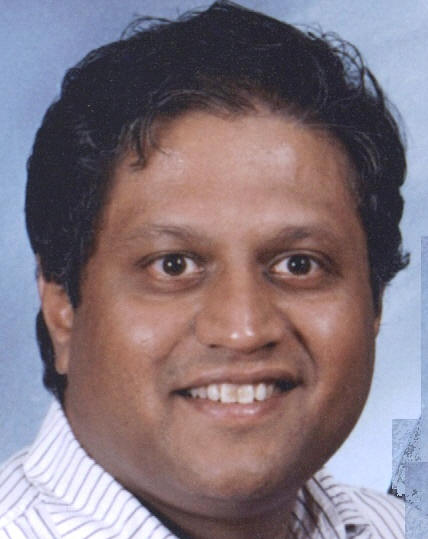
Ramani Duraiswami
Professor, Department of Computer Science and the
Institute for Advanced Computer Studies (UMIACS)
University of Maryland, College Park
Director, Physical Intelligence and Reality Lab (PIRL)
Affiliate appointments in Electrical and Computer Engineering, Applied Mathematics
and Scientific Computation, the Artificial Intelligence Interdisciplinary Institute,
and the Center for Automation Research
I work on machines that hear, and on the numerical methods that make physical models fast and differentiable. Three threads run through it: audio language models, scientific computing, and spatial perception — separate literatures that keep turning out to need each other.
Research
01Large Audio Language Models
Language models that listen — speech, sound and music as first-class input rather than transcribed text. Recent work includes the Audio Flamingo series of fully open audio-language models, now extended to video in Audio-Visual Flamingo and to music in Music Flamingo; GAMA and CompA on audio understanding and compositional reasoning; TEMPO on temporal grounding; and the MMAU benchmarks, which exist because the field could not otherwise say what these models actually understand.
Audio-language models, audio reasoning and captioning, benchmarking and evaluation, speech enhancement, retrieval-augmented audio.
02Scientific Computing and Differentiable Modeling
Fast multipole (demo) and boundary element methods for the Laplace and Helmholtz equations, and the translation theory underneath them. Recent work makes these solvers differentiable: hand-derived tangents and adjoints, so a wave solver can sit inside an optimization loop or a learned model rather than beside one. Much of this is joint work over twenty-five years with Nail A. Gumerov, who died in 2022; the codes are being opened and documented.
The same instinct runs into learning: GAIA studies geometry-adaptive operator learning for forward and inverse problems, where a surrogate has to respect a geometry it was not trained on. Older questions have a way of returning — an exact Navier–Stokes solution Gumerov and I found in 1998 turns out to speak to a 2026 blow-up construction.

Fast multipole methods, boundary integral equations, adjoints and shape derivatives, GPU and heterogeneous computing, operator learning.
03Spatial Perception, with a focus on Audio
How listeners localize sound, and how to reproduce or measure that computationally: head-related transfer functions and their personalization, spherical microphone arrays, room acoustics, and audio-visual scene analysis. The physics and the perception are the same problem seen from two ends, which is why the solver work and this work share a laboratory.
Increasingly this meets the first branch directly: SPUR gives audio language models spatial understanding, and a differentiable multi-sphere scattering model lets spatial cues be studied analytically and optimized rather than only measured.

HRTFs, binaural audio, microphone arrays, source localization, room impulse responses.
Selected work
- S. Ghosh, A. Goel, K. Jayakumar and others. Audio-Visual Flamingo: Open Audio-Visual Intelligence for Long and Complex Videos. Preprint, 2026.
- M. Krishnan, P. Pulijala, K. Chen, H. Yang and R. Duraiswami. GAIA: Geometry-Adaptive Operator Learning for Forward and Inverse Problems. Preprint, 2026.
- R. Duraiswami. Self-similar swirl between contracting porous walls: the GD1998 exact Navier–Stokes solution revisited. Preprint, 2026.
- S. Ghosh, A. Goel, J. Kim, S. Kumar, Z. Kong, R. Duraiswami, D. Manocha, R. Valle and others. Audio Flamingo 3: Advancing Audio Intelligence with Fully Open Large Audio Language Models. NeurIPS 2025.
- S. Sakshi, V. Lokegaonkar, N. Zhang, R. Duraiswami and others. SPUR: Integrating Spatial Audio Understanding and Reasoning into Large Audio-Language Models. Preprint, 2025.
- S. Sakshi, U. Tyagi, S. Kumar, A. Seth, R. Selvakumar, O. Nieto, R. Duraiswami, S. Ghosh and D. Manocha. MMAU: A Massive Multi-Task Audio Understanding and Reasoning Benchmark. ICLR 2025.
- S. Ghosh, S. Kumar, A. Seth, C. K. R. Evuru, U. Tyagi, S. Sakshi, O. Nieto, R. Duraiswami and D. Manocha. GAMA: A Large Audio-Language Model with Advanced Audio Understanding and Complex Reasoning Abilities. EMNLP 2024.
- S. Ghosh, A. Seth, S. Kumar, U. Tyagi, C. K. R. Evuru, Ramaneswaran S., S. Singh, O. Nieto, R. Duraiswami and D. Manocha. CompA: Addressing the Gap in Compositional Reasoning in Audio-Language Models. ICLR 2024.
- N. A. Gumerov and R. Duraiswami. Fast Multipole Methods for the Helmholtz Equation in Three Dimensions. Elsevier, 2004.
All publications · Google Scholar · Semantic Scholar · ACL Anthology · ORCID
Talks
- Transformers Meet Scientific Computing. University of Maryland, September 2026.
- Scientific Computing with and for Machine Learning. UMD Applied Mathematics and Scientific Computation program, December 2025.
- The Music Flamingo model. With NVIDIA, November 2025.
- Towards Auditory General Intelligence. UMD Computer Science, October 2025.
Software
- PIRL codes — fast multipole and boundary element libraries for the Laplace and Helmholtz kernels, with Python bindings and differentiable operators. Being opened; gitlab.umiacs.umd.edu/pirl
- FIGTREE — fast Gauss transforms with tree-based nearest-neighbor search.
- FLAGON — Fortran 9x bindings for CUDA.
- GPUML — GPU-accelerated machine learning primitives.
Spatial audio work from this laboratory underlies technology commercialized through VisiSonics and shipped in millions of devices.
Group
Around twenty graduate students work in the lab, across all three areas above, and eighteen have completed doctorates with me since 2000. Members and alumni. Enquiries from prospective students are welcome by email.
Background
- Ph.D., Johns Hopkins University, 1991. B.Tech., IIT Bombay, 1985.
- Board of Regents Award for Excellence in Research and Innovation. 2016.
- UM Ventures Invention of the Year Award. 2016.
Contact
ramanid@umd.edu
· CV
· LinkedIn
· X
(301) 405-6710
Room 4244, Brendan Iribe Center
University of Maryland, College Park, MD 20742